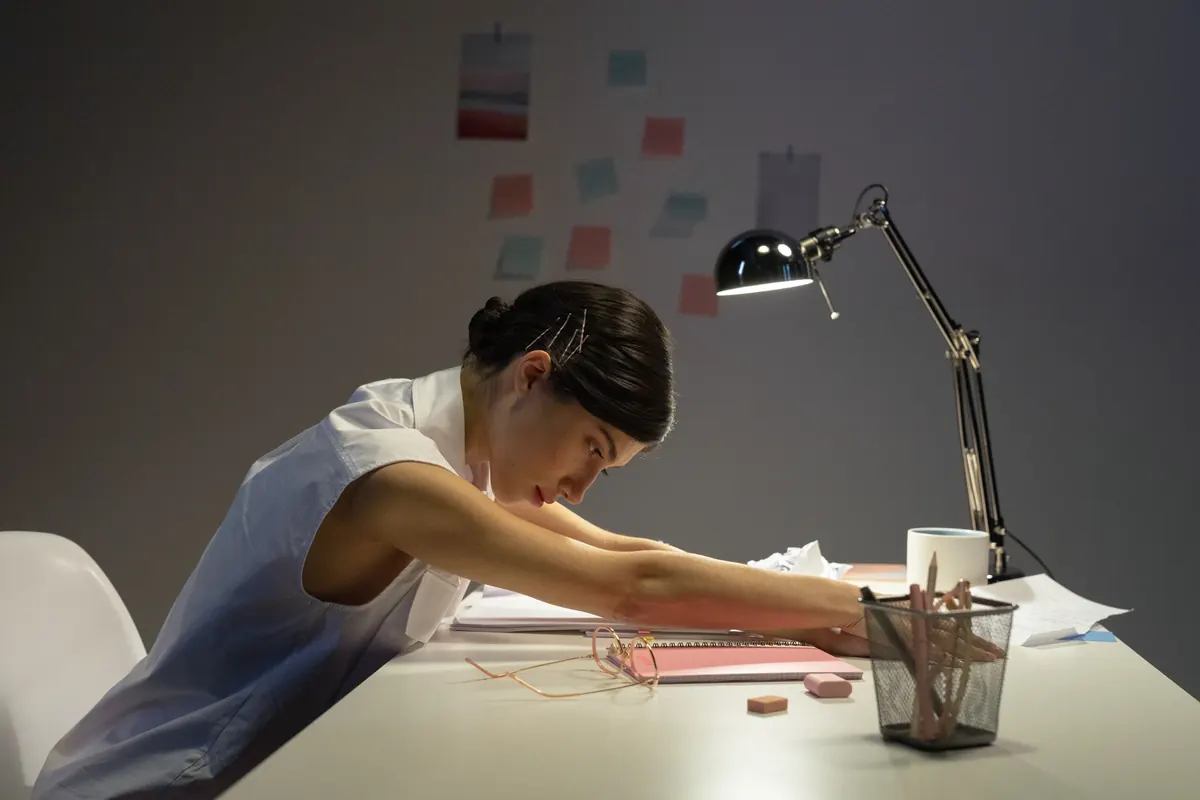
Your body keeps a record of your desk. The shoulders that creep toward your ears by mid-afternoon. The lower back that complains when you finally stand up. The eyes that feel gritty even though you have not left the building all day. None of it arrives at once. It accumulates in small increments, hour after hour, which is precisely why small increments can undo it.
What follows is a checklist of eight habits. None takes longer than ten minutes, most take under three, and every one can be done in the clothes you are already wearing, in the room you are already sitting in. No standing desk, no mat, no subscription required. You only need the willingness to interrupt yourself a few times a day.
The Eight Habits at a Glance
- Stand and stretch every 90 minutes or so (2 minutes).
- Open your chest in a doorway (60 seconds).
- Untangle your hips in the chair (90 seconds per side).
- Look far away, properly, with a real object in view (20 seconds, often).
- Cover your eyes and breathe (1 minute).
- Breathe to a count when your thoughts start racing (2 minutes).
- Write three lines and close a few tabs (3 minutes).
- Shut down deliberately at the end of the day (5–10 minutes).
Read that list once and you already know most of it. The gap between knowing and doing is where the whole thing lives, so the notes below are about execution, not information.
Three Habits for a Body That Sits
1. Stand and stretch, every 90 minutes
Set a timer if you need one, but an anchor works better: when a meeting ends, when you refill your water glass, when you send a message you have been dreading. Stand up, place both hands on your lower ribs, and take three slow breaths while lifting your chest. Then reach one arm overhead, then the other, then roll your shoulders back five times. That is it. Two minutes, no equipment, and you will feel the difference in your neck before you sit down again.
2. The doorway chest opener
Sitting pulls the shoulders forward and shortens the front of the chest. To reverse it, stand in any doorway with your forearms resting on the frame, elbows roughly at shoulder height. Step one foot forward until you feel a gentle stretch across the chest, and stay there for twenty to thirty seconds while breathing normally. It should feel like a stretch, never like a pinch. If you get sharp pain, tingling down an arm, or numbness, stop and have a physiotherapist or doctor take a look rather than pushing through it.
3. The chair figure-four
This one you can do mid-call, camera off. Sit tall, place your right ankle across your left knee, and hinge forward from the hips with a long spine until you feel the right hip and glute release. Hold for about ninety seconds, breathing slowly, then switch sides. Keep your back straight rather than rounding toward the floor. It is the single most useful thing you can do for the tight, achey feeling that builds in the lower back during long stretches of sitting.
Two Habits for Eyes That Stare
4. The 20-20-20 rule, with an actual object
Every twenty minutes, look at something about twenty feet away for twenty seconds. The rule is everywhere; what most people skip is the object. Pick a specific target — the tree outside the window, the building across the street, the far corner of the room — and let your focus genuinely land there. Letting your eyes drift vaguely toward the wall while you keep reading does nothing. And while you are at it, blink deliberately a few times; screen work tends to make people blink less, which is part of why eyes feel dry by evening.
5. Palming, for one minute
Rub your palms together until they feel warm, then cup them over your closed eyes so the eyes are in darkness without any pressure on the eyelids. Breathe slowly and stay for a minute. It is not a cure for anything, but it is a genuine pause for eyes that have been fixed at the same distance for hours. If you regularly get headaches, eye pain, or blurry vision that clears when you look away, book an eye test — that is a conversation for a professional, not a checklist.
Two Habits for a Mind That Won't Switch Off
6. Counted breathing
Inhale through the nose for a count of four, exhale for a count of six, and repeat ten times. The longer exhale is what does the work; it gives your nervous system a clear, physical signal that nothing urgent is happening. Two minutes, eyes open if you prefer, no app needed. If breathing exercises make you feel tense or dizzy, shorten the counts or simply slow your exhale without counting at all.
7. The three-line brain dump
When the tab count climbs and everything feels equally urgent, take a piece of paper and write three lines: the one thing that actually matters today, the thing I am avoiding, and the thing I am allowed to leave until tomorrow. Paper beats a new app here, because the point is to get the loop out of your head and onto something you can see. Three minutes, and the afternoon usually gets quieter.
Habit Eight: A Proper Shutdown
The last habit is the one most desk workers skip, and it is the one that buys you the evening back. Set aside five to ten minutes before you finish: close the tabs you are not returning to, write down the first task for tomorrow, clear the surface of your desk, and say something to yourself that marks the end — a short sentence, out loud or in your head. It sounds slightly silly until you have done it for a week. Then you notice that you stop mentally rehearsing work at 9 p.m., because the day already had a closing bracket.
How to Keep the Checklist Alive
Do not start with all eight. Pick two — the stand-and-stretch and the eye break are the easiest — and run them for a week before adding anything else. Attach each one to something that already happens in your day, so you are not relying on memory or motivation.
- Attach, don't schedule. Chest opener after every coffee refill. Figure-four during the weekly call that always runs long.
- Accept the small version. A twenty-second stand still counts. Missing the ten-minute version is not a reason to skip the one-minute one.
- Put it where you can see it. A sticky note on the monitor edge beats an app you have to open.
- Skip the streak guilt. This is a set of tools, not a competition. Days off are part of the design.
One sensible caveat: this checklist is general wellbeing advice for healthy desk workers, not treatment. If stiffness, pain, numbness or eye discomfort persists for more than a couple of weeks, or gets worse rather than better, speak to a doctor or physiotherapist. Ten-minute habits are excellent at preventing the small stuff from becoming the big stuff — that is the whole point — but they are not a substitute for proper assessment when something is genuinely wrong.
Start tomorrow with two of them. By Friday you will know which ones fit your day, and by next month the good ones will have stopped feeling like a checklist at all.
Photo: cottonbro studio / Pexels